Maternity fitness series: Are core exercises off limits during pregnancy?

Posted: December 22, 2025
This is the fifth blog in a series that aims to empower you throughout your pregnancy and postpartum journey by debunking common myths.
Throughout your pregnancy, you may want to stay active. Exercising while pregnant can increase your chances of having a healthier baby, a healthier delivery and a healthier recovery process.
But it’s important to choose exercises that are safe for you and your baby. The experts at Sanford Sports in Sioux Falls are debunking the myth that core exercises are off limits during your pregnancy.
Pregnancy core exercises
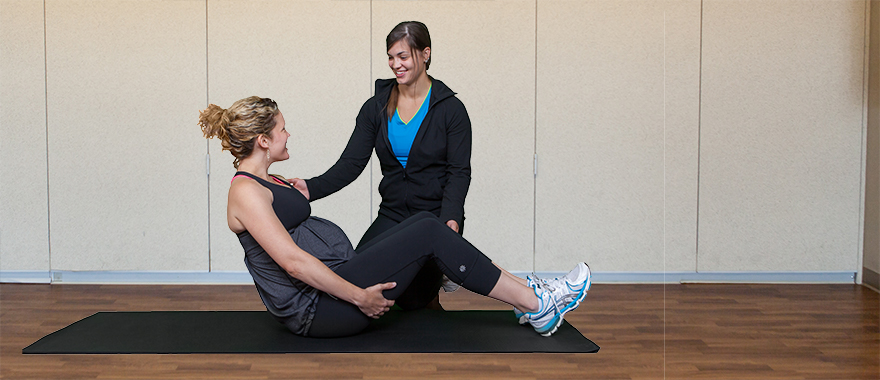
Avoid any core exercises while you’re pregnant that would cause your abdomen to dome or cone, such as push-ups, sit-ups, crunches and planks.
Instead, try doing breathing, pelvic floor strengthening and abdominal activation exercises. These can help you maintain your core strength into postpartum and help decrease abdominal muscle separation.
Postpartum abdominal muscle separation
Once your doctor has cleared you to exercise postpartum, continue to avoid push-ups, sit-ups, crunches, planks and any other exercises that would cause your abdomen to dome or cone.
Your abdominal muscles are still recovering from being stretched during pregnancy and may have more space between them than normal. This is called diastasis recti, and most mothers will experience it.
To determine if you have diastasis recti, feel the space between your ab muscles. If this space is the width of two or more fingers, talk to your provider.
Diastasis recti management
In addition to space between your ab muscles, you may experience lower back pain, difficulty walking or difficulty lifting objects. These signs may not be noticeable until several weeks postpartum.
Strengthening your core is essential to your recovery. If you need additional help managing diastasis recti, contact a Sanford Health pelvic floor physical therapist.
Postpartum core exercises
Here’s a step-by-step guide to help you strengthen your core postpartum.
Pelvic Floor Muscle Contraction
- Get into a comfortable position. Choose a position that feels easiest for you (hook lying, seated or side lying).
- To prepare for the exercise,
- Inhale and relax: As you breathe in, focus on relaxing your pelvic floor muscles.
- Exhale and contract: As you breathe out, gently tighten your pelvic floor muscles.
- Hold the contraction: For the first set, hold the contraction for 10 seconds, then relax. Repeat this for three sets with rest between each.
- Quick contractions: After the long holds, perform three sets of 10 quick contractions, each lasting one to two seconds.
Posterior Pelvic Tilt
- Start by lying on your back with your knees bent and feet flat on the floor (hook lying position).
- To prepare for the exercise,
- Inhale and relax: As you inhale, allow your abdominal muscles to relax.
- Exhale and engage: As you breathe out, gently tighten your abdominal muscles while flattening your lower back.
- Hold for 10 seconds.
- Repeat six times.
4-Point Upper Extremity Reach
- Start on your hands and knees. They should be shoulder width apart (four-point position).
- To prepare for the exercise,
- Inhale and relax: As you inhale, allow your abdominal muscles to relax.
- Exhale and engage: As you breathe out, gently tighten your abdominal muscles and extend one arm straight in front of your body.
- Hold for five seconds and bring your arm back to the starting position.
- Repeat with the opposite arm.
- Complete two sets of five repetitions.
Clamshell
- Start by lying on your side with your hips stacked and your knees and hips flexed (side lying position).
- Keep your knees bent and slowly raise your top leg up, keeping your feet together.
- Repeat on the opposite side.
- Complete two sets of 10 repetitions.